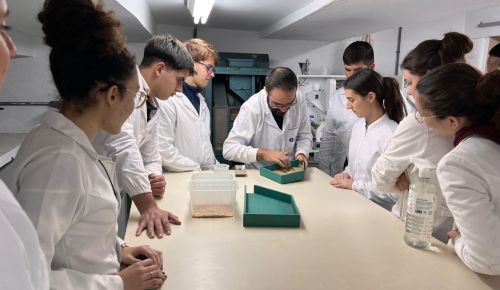
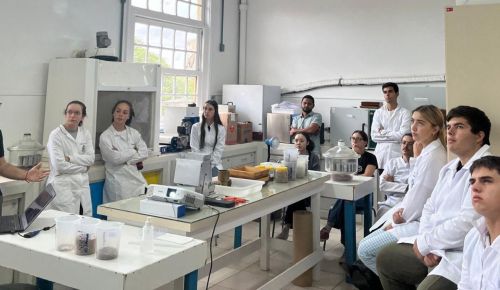
The rice production chain in Pelotas and the surrounding region will be the focus of a new innovation project led by InovAgro, a unit of the Federal University of Pelotas (UFPel) accredited by the Brazilian Industrial Research and Innovation Company (Embrapii). The initiative foresees an investment of R$ 750,000 over two years for the development of technologies geared towards the rice industry, a sector considered strategic for the economy of southern Pelotas.
In addition to technological development, the project also seeks to bring students and researchers closer to the industrial environment. InovAgro brings together approximately 300 people, including professors, researchers, technicians, post-doctoral fellows, doctoral students, master's students, and undergraduate students.
InovAgro recently became a "gold unit" of Embrapii. This classification is given to the most outstanding units within the national network. According to the maturity coordinator, Gabrielito Menezes, this achievement expands the capacity for investment in projects related to agribusiness. “We are the only unit with specific know-how for agribusiness. The unit was created within the Eliseu Maciel Faculty of Agronomy (FAEM/UFPel), which has 142 years of tradition in agriculture. And now, as a gold unit, we have received the challenge of developing new skills. We chose to focus on the rice chain,” he states.
The initiative will be built in partnership with the Pelotas Rice Industry Union (Sindapel) and will involve the formation of a Technical-Scientific Committee (CTC), bringing together the university, Embrapii, and companies in the rice sector. The objective is to directly hear the demands of the industry before defining the research and technologies that will be developed. “We don't want to innovate alone. We want to innovate together with the sector, listening to the pain points and understanding the reality of the rice chain,” emphasizes Menezes.
The executive advisor of Sindapel, Daniele Braga, believes that the project's differentiating factor lies precisely in the collaboration between the university and the private sector. “There are many public policies aimed at rural producers, but few directed at industries. This project strengthens the relationship between the public and private sectors, bringing innovation to a sector that generates jobs and income in our region,” says Braga.
According to her, the focus will be on developing technological solutions that many companies would not be able to finance on their own. “Embrapii provides access to research and innovation. We are talking about technologies and studies that industries often cannot invest in privately,” she explains.
Among the topics already preliminarily discussed by the group are the utilization of rice waste, the use of bran, and research on isolated protein from the grain. Even so, the priorities will be defined by the new technical-scientific committee. “The most important thing is that companies will point out what the real needs are. From there, viable solutions for the sector will be devised,” reinforces Menezes.
According to him, the proposal also helps in retaining talent in the region. “Today we work a lot on developing soft skills, entrepreneurship, leadership, and communication. Many students end up being hired by companies. This helps to retain talent here in the region,” she says.
Daniele Braga also highlighted the economic importance of the rice industry for Pelotas and the south of the state. “Our region is the largest rice processing hub in Latin America. Many times we don't recognize the potential we have here,” she concludes.
Learn more at: https://wp.ufpel.edu.br/embrapii/
Follow us on social media: @inovaagroufpel and @lab_graos